We see everyday in many organizations that when something isn’t working well, there is a movement to blame outdated tools and then we try to fix the issue, usually by adding a new and revolutionary tool or creating another layer of process that will resolve everything.
At first glance due our bias it this feels like it’s right.
But usually, the problem isn’t a outdated or lack of tools or systems. Most of the time is the lack of structure, clear processes, inconsistent, or simply more complicated than they need to be. We notice sometime that people who are not confidence try to make things seems or actully be more complex than needed.
Over time, teams start working around the process instead of with it.
Process improvement, when well applied, doesn’t require a bigger transformation. In many cases, small and intentional changes are enough to create meaningful improvements in how work flows.
Processes usually format how work actually happens inside an organization.
When they are not clear or not well designed, the negative impact shows up in day-to-day work, even sometimes it is not easy to see it from the inside. Consequently, teams starts to experience:
Individually, these might seem like minor issues. But over time, they accumulate and start affecting productivity, collaboration, and even team morale.
Well-designed processes, on the other hand, create clarity. And it is clarity that what most of the teams are actually missing.
These methods are easy to apply, adaptable, and work well in most team settings. They don’t rely on specialized training or complicated frameworks, just an openness to reviewing how work gets done today.
The first step in improving any process is mapping your process taking in considerations different perspectives from different levels among team members and understanding it.
Process mapping involves visualizing the workflow from inbound to outbound. This doesn’t need to be complicated. In many situations some team members already have this and if not a simple outline is enough.
Start by:
Sometimes, just mapping the process is enough to spark immediate improvements.
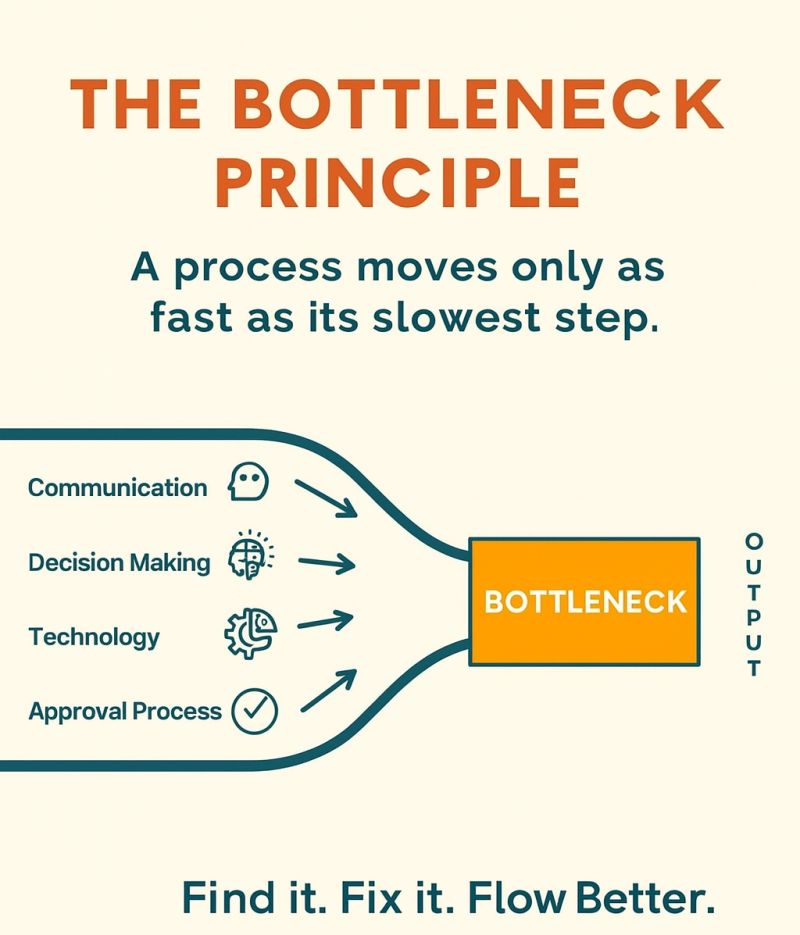
Once the process is mapped, the next step is to look for things where your process turn slow. The well know botlenecks.
Bottlenecks are points between the inbound and outbound process that brings some constraints in the workflow. Sometimes, as a consequence, it can stop or get delayed, impacting the entire process chain. They’re often the reason timelines slip or tasks pile up.
The most common examples are:
So, the best approach is always trying to clarify who is responsible for waht nad review the times among the process and adjusting it when needed
Sometimes as mentioned above, peolpe add some steps on the process because they are not confident but they can keep their jobs because of the complexity, but this doesñ’t bring any value.
Over time, processes tend to accumulate extra steps, often introduced with good intentions, or becausee lack of confidence, but they are not necessary.
A good exercise is when your are not busy, that’s is difficult to realize when you are in the middles of fire, to pause and ask:
You do not need to reinvent the wheel. Only removing one or two unnecessary steps can turn a process fast and easy to follow.
Every single day we see that mostly in small to medium size different team members approach the same task in different ways.
When we talk about standardization, we are not saying that things have to be set in stone. Mainly, what we expect is having a shared baseline, and a common understanding of how tasks should be done.
This helps create:
We do not aim to exclude flexibility, but to have more understanding and clarity.
Usually during braimstorms teams come up with the idea to solve solve process issues we need a more sophisticated and top-notch tools.
Actually, mos of the time, complexity is part of the problem and not the tool.
Simple tools are often enough to support well-designed processes. For example:
When tools are easy to use, people are more likely to adopt them consistently, which is what actually drives improvement.
Every time that you get to the point where a process is clear and stable, we can add automation to help reduce manual work.
This is most useful for repetitive and tedious tasks such as:
However, automation should be applied with caution. If you start automating a process that is not entirely rounded usually it will makes the problem in your process happen faster.
But when applied to the right areas, it can free up time and reduce errors.
Finally. we would say the most imortant point in process improvement is that it’s never truly finished. You have to keep in mind that it is “working in progress.”
Everything is changing and evolving over time. Teams grow, people move, priorities shift, etc.
So again, instead of looking for a perfect solution, it’s more usuful to:
These small changes are often more sustainable—and more impactful—than large, one-time redesigns.
Just a final reminder, process improvement isn’t about perfection.
Small changes can have a much more meaningful impact when applied with consistency.
And in many cases, that’s all it takes to transform how a team operates.