Key elements of a strong document workflow
A good approach for a document management workflow does not need to be complex, difficult and tedious. It needs to be clear and consistent.
- Clear structure – Folders or document libraries should be shown and structured in the way that teams actually work. Instead of using generic or individualized structures, it should be organized based on:
- Projects
- Functions
- Teams
- Operations
- Naming conventions – Simple naming rules can make a significant difference also because there are some pitfalls when you use cloud folders. Most cloud services have a limitation based on the structure when you want to share a document, and the name of the file or document plays a huge role in that in fact. For example, you could use the following name convention:
- ProjectName_DocumentType_Date
- Avoid vague names like “final_v2_updated”
- Avoid personal notes in the name like “my-notes”, “for-review-Tuesday, etc.
- Version control – The main idea here is to establish first that we are going to work online and only with one live document. So this would be always a clear “source of truth.” Using tools like SharePoint allows:
- Version history
- Controlled editing
- Reduced duplication
- Permissions and ownership – It is also really important to define and clarify roles and permissions for a specific folder or, if needed individual documents:
- Who owns the document (that means which teams, department or project that the main folder pertains to)
- Who can edit (all members in the project need to edit, all of them are going to work on the documetn? Which credentails they actually need for that specific folder?
- Who can view (many of the times, some people who are not actually working on the document should have minimal access, mainly view or comments permission)
This will help assure and reduce accidental changes and confusion.
- Document lifecycle – Not all documents need to be active and live forever. The best approach is to work with retention timeframes, so you can make sure that when you open a document library (folder) for that specific team, program, initiative, project, etc, you will only find documents that are relevant for what you are currently working on. So it is important to define stages such as:
- Active
- Archived
- Archived with restricted access
This keeps systems clean, manageable, and not overwhelming. What is more, most of the applications and platforms, such as SharePoint, allow you to set up these rules to automatically perform the retention business rule defined by your organization.
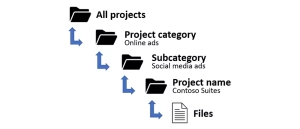
Here you can see a practical example
Without a workflow:
- Documents are saved locally, mainly in individuals’ desktops
- Shared by email always creating the need to someone collect responses and put all the feedback together in a final version
- Multiple versions exist. Meaning that you never know which document is the most updated and reliable document you have to work or count on.
With a workflow:
- Documents are stored in a shared location, turning accessibility simple and clear
- Access is controlled by the owners of the document library, making sure that only people who need access will have it
- Updates happen in only one place, and you can be confident that you have only one version and can even track any changes or comments, and if needed, restore previous versions if someone changes something by mistake
- Everyone works on the same version, so there is clarity on where and when the document is created, edited, and ready to be shared if it is the case
This simple shift alone can significantly improve efficiency and help in what in the end of the day counts to be profitable.